

Female Baraka: Gendered Authority and Presence in Moroccan Spiritual Spaces
In Morocco, mysticism breathes beneath the surface of everyday life. It rises from the rhythm of hadra circles, from the dust of pilgrimage routes, from the quiet faith people place in dreams, blessings, and unseen forces. It exists parallel to orthodox beliefs sometimes embraced, sometimes condemned, always present. Sufi orders, saintly lineages, and healing rituals shape the moral and emotional landscapes of cities and rural enclaves alike, offering people a language to speak their fears, their hopes, and their unseen wounds.
Yet within these mystical worlds, where baraka flows and spiritual authority is deeply revered, women walk a far more fragile path. Their presence is tolerated only when it is silent, hidden, tamed, and domesticated. A man who communes with the spirits is a faqih (expert) or a charif from holy lineage, either way, a vessel of divine knowledge and grace. A woman who does the same -despite her exclusion from spirituality and charaf by genealogy- is all too easily branded demonic, possessed, and morally dangerous, a woman who fell from grace. Her knowledge is suspected, her body is a site of scrutiny and her authority is never really her own.
Still, women persist. They persist in shrines and weekly markets and occasional Moussems, in dim backrooms and makeshift stands, in the liminal spaces where people come seeking healing, comfort, or a glimpse into the unseen. They persist because their work fills emotional and spiritual gaps no one else addresses, because the myths and histories of Morocco leave room for women who negotiate with the sacred, who found their way around lineages into accessing what is holy, what is not granted to them by inheritance, what was not meant for them yet found them.
Baraka beyond Charaf
In Le Chérif et la Possédée, Zakaria Rhani explains that baraka defines the spiritual condition of the walī and refers not only to the ability to perform miracles, but also to a presumed prophetic lineage, known as charaf. While baraka was originally understood as a personal, charismatic, and miraculous quality, since the 17th century it has increasingly been expressed through genealogy and hereditary transmission. Charaf, which literally means nobility and honor, refers in the Maghrebi context to biological descent from a saint who traces lineage back to the Prophet Muhammad through his daughter Fatima. This genealogical connection places the chorfa in a position of symbolic power and sacred authority.
However, a rupture in the logic of charaf was introduced through the myth of Lalla Aicha, access to baraka is no longer conditioned by genealogical affiliation or hereditary charaf. Instead, spiritual power becomes available to those excluded from saintly lineage; women and effeminate individuals, who would otherwise have no claim to such authority or blessing, can receive it through their relationship with her. through participation in rituals, and direct interaction with her spirit in sacred spaces, which allows these marginalized actors to become intermediaries, healers, or conveyors of the saint’s power. In this way, Aicha creates a parallel channel of spiritual legitimacy that runs outside the established, hereditary system of charaf, giving the socially peripheral access to power that is normally reserved for male descendants or formally recognized disciples (Mouna 2018).
Sought by Many, Abandoned by All
Aicha is the world in which I met two women whose lives were shaped and undone by the spiritual gifts they carried: Mi Keltoum, a clairvoyant seamstress from Meknes, and Houria, a henna artist who reads destinies through the strokes on women’s palms outside the mausoleum of Wali Al-Hadi Ben Aissa. Their paths never crossed, yet their stories echo one another as two women navigating the thin line between reverence and rejection, between the baraka they offer and the violence they endure, between empowerment and risking losing all sense of agency.
In 2015, I met Mi Keltoum, a seamstress, clairvoyant, and devoted follower of Lalla Aicha. Over the years, during my bimonthly visits to her tiny tailor shop in the old Medina of Meknes, we developed a personal relationship built on trust and quiet ritual: a cup of mint tea, the hum of her sewing machine, and her soft voice weaving stories between stitches. It didn’t take long before she opened up to me about the true nature of her work.
She was a middle-aged, tanned, short, thin woman with a light presence. Her bright, cheerful attitude made her appear unburdened, but she carried an ancient heaviness, one that women in spiritual work often inherit without choice. She took up space and carried herself with confidence, yet moved with the wisdom of someone who knew how quickly that space could be stripped away. I found myself turning to her many times for guidance, drawn to the precise way she always knew what to say at the right moment, as if someone whispered truths into her ear. She describes herself as someone abundant, content and blessed, “ma’andich o makhassnich” (I don’t have much, and don’t need much) she also constantly repeats “li khlqna yarzaqna” (The one who created us provides for us).
By the fourth year of our acquaintanceship, she finally told me the captivating story of how she gained access to baraka. It began with a dream she had as a teenager when she had just underwent puberty; “after I had my first period, I showered and went to sleep where I had a vivid dream…almost as if my soul had left my body into a surreal realm, a huge snake visited me in my grandparents’ house and led me to a dead fig tree on a hill – a place I did not know existed at the time but I remembered the directions, then it died there. In the morning, I told my mom and she took me to Mrhassiyine, a small location near Meknes, where my grandparents are from, and I followed the same directions and actually found the same tree. At that moment I fell to the ground, it was my first time experiencing a trance.” she believed she had been chosen by Lalla Aicha herself and granted a gift, that she used discreetly to help and heal people, to read their fortunes, and to soothe aches that modern medicine could not reach.
Mi Keltoum lived with her husband, Omar, an artisanal footwear merchant, and their only son. Omar, a member of the Brotherhood of Issawa who was trying to climb the maqāmāt ranks, always struggled with his wife’s spiritual authority. His discomfort was constant and palpable, a fear that word might spread that his wife was a seer whose source of power came from a female saint. For him, male mysticism was celebrated, a sacred, and socially valued discipline. Female mysticism, however, was demonic: a threat, and a stain on a lineage.
Despite attempting to control and limit her spirituality, Omar still benefitted from it, he regularly ordered her to perform “qoboul” rituals for his business to attract clients, to protect against jealous rivals, to open doors he couldn’t open alone. “A never would never want you to be able to survive without him, let along surpass him, my dear.” She justifies. “For Omar, a woman’s baraka is acceptable only when confined within the home, and used for the benefit of her husband and family. I love my husband, back in my day we did not have the freedom to choose who we get married to, but I was lucky enough, Omar and I love each other, Allah and salihin opened my heart to him only. You know I was very beautiful when I was your age, a lot of rich men proposed to me but I never liked any of them and neither did they, they would come to me at night and warn me that they would be displeased with me if I married them. They wanted me to marry Omar.”
Then came the pandemic. With the Medina shutting down and her sewing machine going silent, Mi Keltoum moved her alternative work online. She began offering readings over the phone to her loyal clients, not out of desire but out of necessity. The family needed income and Omar fully supported the venture at the time. Her project flourished, especially in a moment of collective despair when everyone sought meaning, comfort, and a glimpse of something beyond the chaos, a belief in something bigger and higher than themselves, mysticism gained sudden unprecedented popularity. Her voice became a refuge, her name circulated and more people sought her, and that was the beginning of her downfall.
By 2022, as people resumed their routines, Omar found himself excluded from his own spiritual community. Whispers spread and side glances lingered at the man whose wife possessed forbidden authority, a man whose spiritual legitimacy was now questioned. Resentment grew inside him, festering until it finally erupted. His feeling about his wife and her practices quickly shifted, their marriage collapsed, as his wife put it “our love was no match to his feeling of shame, he forgot our companionship and bond and did not think of our son, he thinks I am a bad mother who will corrupt him, that I am a kafra! Only now, Subhan’Allah!”
After a long custody battle, he won full custody of their son. Mi Keltoum’s own family disowned her shortly after claiming “a divorced woman is no daughter of ours…let along one who is a witch”. With no formal education, no stable job, no home, no community, and no support system of any kind, she was left with nothing but the myth—and now her reality—of the woman she had always followed: Lalla Aicha.
Perhaps she turned to Aicha because she is seen as a mother figure, something she desperately needed. Perhaps it was because Aicha herself had her home, dignity, and safety stripped away in an instant. Or perhaps Mi Keltoum simply sought connection with something higher, that would not abandon her. Whatever the reason, she eventually sought refuge at the shrine of Lalla Aicha in Sidi Ali Ben Hamdouch, where she now lives as a shell of her former self, wandering the sacred grounds and repeatedly calling out her son’s name or calling out for Lalla Aicha’s help.
Some of the people who were once her clients visit her there, still seeking her baraka. Some believe that having lost much of her consciousness, she is now even more powerful—her body fully surrendered to spirits that her sanity can no longer contain as Anass, an effeminate man I met in Sidi Ali who moved there indefinitely, seems to believe; “ Lmima offered that woman a pact but she kept refusing, it was not until she left her family behind and broke all of her attachments that she completely surrendered herself to ljwad, now they have taken over her body so we can directly contact them through her, when you speak to Kltouma now, you are speaking to them”.
However, when these seekers receive nothing from her, disappointment turns quickly to cruelty. They shame, mock, and accuse her of demonic acts that supposedly caused her condition. The woman who once nourished them with comfort is now used as a warning, a spectacle, and a cautionary tale. One thing remains certain: Mi Keltoum, as nurturing as she always was, lived in a world where people only wanted to take from her, spiritually, emotionally, financially, until there was nothing left.
Houria: fortune in palms, violence in plain sight
If Mi Keltoum represents the collapse that happens inside the confined parts of mystical authority, then Houria, a henna artist at Cheikh Kamel, represents what happens when this authority is practiced in public, in broad daylight, with no walls to soften the blows.
I first met Houria during the annual Moussem in the streets of the old Medina of Meknes known as “Lhdim”, where visitors from all over the country bring offerings (incense, expensive gifts, candles, and a variety of sacrificial animals to the Wali Al-Hadi Ben Aissa, and whichever entities they are inhabited by, that accompany the Wali in his shrine. The air was heavy with smoke from incense, and the sound of drums orchestrating the Issawi chants guided the visitors accompanied by livestock through the streets to get to the mausoleum. Amid the tents, vendors, and pilgrims, she sat at a small plastic chair near the entrance of the mausoleum, a place both central and dangerous.
Houria is a woman of striking presence: tall, warm-skinned, big hazel eyes lined in kohl, her hands stained deep red from years of work with henna. Around her are small bowls of powdered henna, rosewater, rose petals and herbs arranged like ritual tools. But it wasn’t her art that drew clients to her, it was her reputation. Houria does not simply draw henna, she reads.
As she decorates a client’s palm, she traces symbols and little dots dedicated to Lalla Aicha, invoking her blessings. Through the patterns, she reads the client’s fortune—marriage prospects, travel luck, hidden enemies, protection from harm. Houria believes Aicha granted her this ability: “L’baraka katji men l’khatt”, she once told me. “The blessing comes through the lines.”
Her work, unlike Mi Keltoum’s, is not hidden. Her shrine is the open street, her sanctuary is a plastic stool. And because she works in full view, she is exposed to the harshest form of violence, the kind that people feel justified inflicting in public. Every day, Houria faces abuse from three fronts: Visitors—tourists and locals—, pilgrims, and male competitors.
She says that many who wander near the shrines do so with moral superiority. They reject mysticism, consider it blasphemy, yet approach Houria only to taunt her:
“Hadshi shirk.””this is blasphemy”.
“Bhalk li kay’kherjolna ela nsa” “your alikes ruin our women”.
“They laugh as I work, insult her client, throw objects at me, call me names, and some even film me… they dignity for online views.”
During my stays with her I would notice pilgrims who consider her impure, paradoxically, those who come as believer see readers as pollutants, a threat to the sacredness of the space. Men in white brush past her aggressively while muttering prayers under their breath “Astaghfir’Allah”, “la hawla wa la quwata ila bi’Allah”…
Houria’s work threatens local male competitors as well: readers, fqihs, and maalems. These men form a tight circle around the mausoleum and do not tolerate female presence. They spread rumours about her, sabotage her materials, frighten her clients, and sometimes corner her in broad daylight to scare her into leaving. In the first times I frequented her stand and before I was marked as one of her regulars, these men have repeatedly attempted to lure me in, claiming that they would do a better job at reading my fortune and undoing curses that –according to them—have been put on me. I had gotten used to hearing their expressions “come here, we studied the discipline we know what we are saying, she is a fraud…”
“Li rshna b’lma n’rshouh b’dem” (we spray with blood those who spray us with water) she utters threatening them. She is alone, with no protection nor a stand or shop to retreat into and yet, she refuses to leave. “Lmima Aicha hiya li dayra liya ddahr” (mother Aicha has my back) she once told me with bravery in her voice and fire in her eyes, those of a woman fighting a battle she knows she cannot win, yet one she cannot abandon because her livelihood depends on it.
Two Women, One Pattern
Though their lives differ, Mi Keltoum and Houria share the same archetypal story –one lived privately, the other publicly. Both exercise spiritual gifts associated with feminine power, draw their authority from Lalla Aicha, navigated spaces where female mysticism is simultaneously desired and condemned, provide services that people eagerly consumed yet socially rejected. Both were punished, violently, clearly, relentlessly for crossing boundaries men are allowed to cross without question. Where Mi Keltoum was quietly erased from her home, community, and sanity, Houria is eroded daily in full view of the world, humiliated to the point of erasure and invisibility. In the end, their stories mirror how women with l’baraka, women who hold spiritual authority have successfully transgressed the social norms of gender through persistence; they persisted in the face of exclusive circles and lineages, of social customs, of gendered expectations, and continue to persist against everyday adversity.
Niama Ifleh
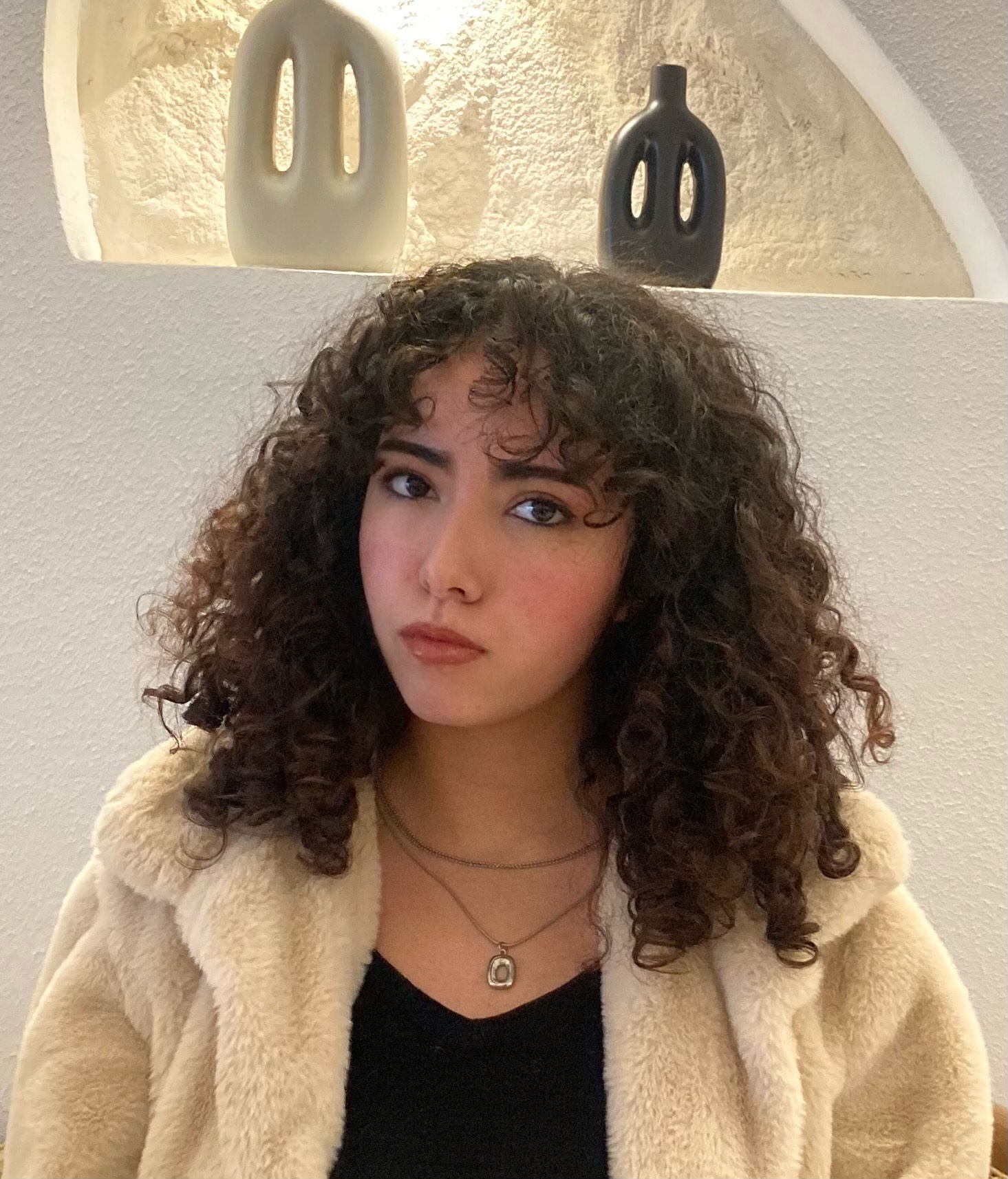 | Niama Ifleh is a volunteer in human rights, feminist and heritage-based initiatives and researcher in cultural and gender studies at the University of Kenitra, whose work engages gender, spirituality, and maraboutic cultures. |
| Ce texte a été réalisé dans le cadre de la session Storytelling pour l’égalité entre femmes et hommes, avec le soutien de l’Institut français du Maroc. À lire aussi en traduction arabe ici et sur Enass.ma. |  |